

Chemistry describes the attraction or spark you feel with someone. Compatibility asks how your lives, needs and choices fit when you make plans, disagree and care for one another.
You do not have to choose between excitement and practical questions. A strong spark deserves time to learn, and a good match on paper does not create an obligation to feel romantic interest.
Four conversations beyond the initial spark
Read the guide as text
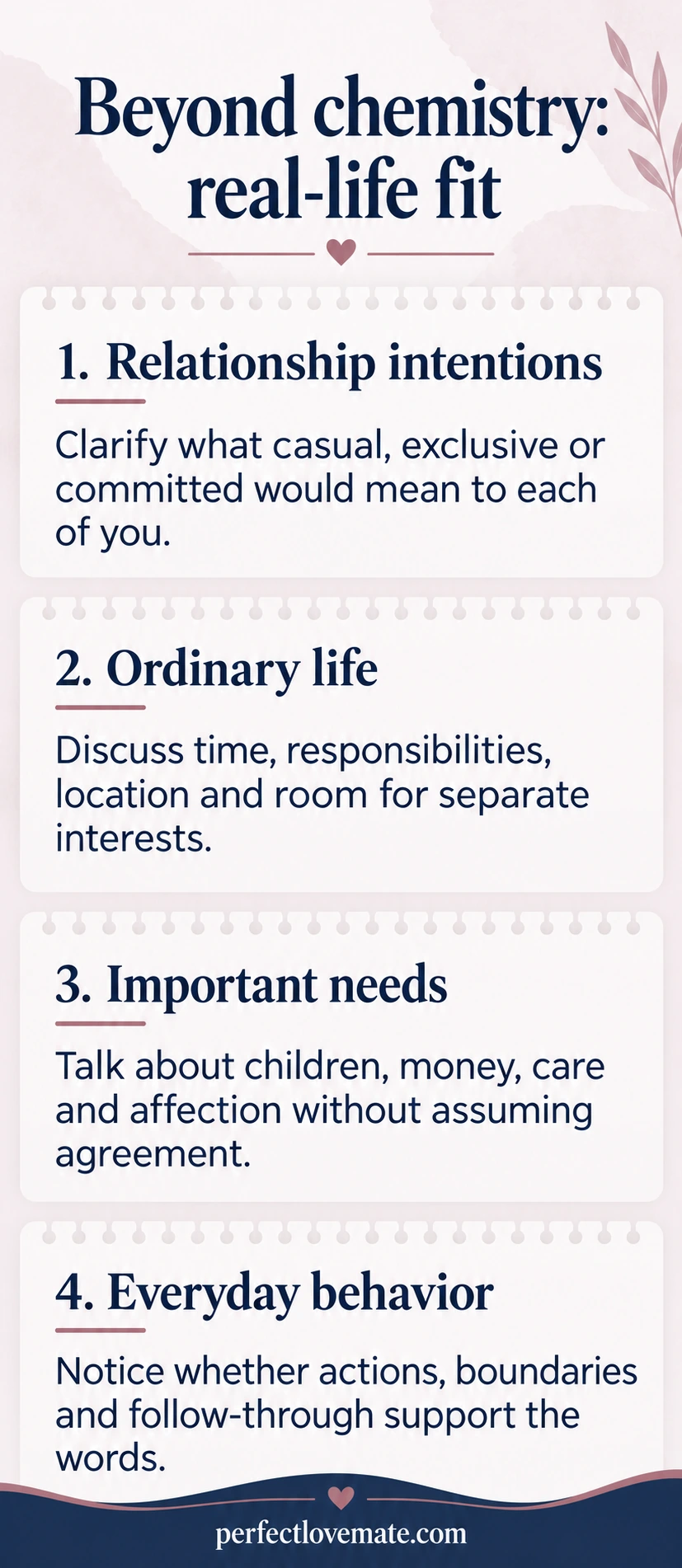
- Relationship intentions. Clarify what casual, exclusive or committed would mean to each of you.
- Ordinary life. Discuss time, responsibilities, location and room for separate interests.
- Important needs. Talk about children, money, care and affection without assuming agreement.
- Everyday behavior. Notice whether actions, boundaries and follow-through support the words.
Chemistry is a feeling, not proof of compatibility
Enjoying being out with someone, feeling desire, and looking forward to seeing them are important. You don't have to distrust a connection just because it feels exciting. At the same time, intensity doesn't mean kindness, honesty, availability, or shared goals. These need different information altogether.
You might feel that chemistry with someone who wants a different kind of relationship, but you also might need many dates before the attraction is clear to you. Neither of these gives a universal rule for what you need to do.
If you go on a date and you have great conversations and a strong attraction but your date wants to move abroad, and you want to stay close to family, this doesn’t mean that the spark is fake; it just means that you need to talk about practical stages before making commitments.
What Does Life Look Like?
Talk about ordinary life. What are your work hours, how much private time do you need and which responsibilities shape your evenings? How do you go about social plans?
These things can show if the differences are easy to accommodate or if they would need one of the people to change their routine completely. Do not assume that because your hobbies match, it means your lives match. Two people might love to travel but still have different needs when it comes to money, comfort, time away from children, or other responsibilities.
Ask your date what an ordinary week looks like for them and listen for activities and responsibilities. You're learning whether there's room for both of you in the relationship, not just trying to have the same calendars.
Talking About the Relationship
Saying things like "casual," "serious," "exclusive," "committed," and "independent" means different things to different people. Ask what the person needs when they say these things. Are they looking for a partnership, an occasional date, marriage, living together, or something else? What agreements do they expect to have in a relationship and in communication?
You don't have to answer a future promise after one day, but you can ask broad questions so that you can avoid misunderstandings later on.

Say something like: "Well, if things go well, what kind of relationship do you hope to build?" Someone can be interested in you and still want a structure that you don't want. Have clear communication that you both choose without needing to make the person a villain.
Children and Family Commitments
Whether you have or want children belongs in conversations about the future. Talk about wishes and responsibilities directly. Whether you want children, don't want children, or are already a parent, you need to understand what the person you're dating feels about it. Do not assume that one person will change minds because you have a strong connection.
Other family commitments can also change compatibility, such as caring for a parent, living close to relatives, sharing a common culture, or having obligations to children in another relationship. Consider these commitments as part of the person’s actual life.
If you're attracted to someone who wants to have a weekend away and you parent on a fixed schedule, you should talk about whether other kinds of time together work. This doesn't mean you have to present your children as an obstacle in order to keep the chemistry alive.
Discussing Finances
One important thing is financial compatibility. This doesn't mean you have to have the same income. It involves whether you can talk about obligations, spending, saving, debt, and decisions that affect each other.
You might ask them how they plan for expenses and what money decisions they expect partners to make together. Keep these conversations proportionate because you don't have to exchange account details to discuss feelings about money.
MoneyHelper’s guidance offers questions about financial responsibilities and arrangements. It is UK-based, so legal and credit details should be checked for your location.
Before you share property, borrow money or take big financial steps, get the right advice. Feelings alone don't replace understanding of the commitment. You can ask practical questions while remaining hopeful about the relationship.
Understand How Each Other Shows Love and Support
Everyone has different ways of showing love and caring for someone, and what makes one person feel supported might not be the same for another. For example, you might want to talk about everything that happened after having a stressful day, while your partner might prefer having some quiet time before discussing anything. Someone might feel loved when their partner listens to them, while someone else might appreciate having help with everyday responsibilities. Neither way is necessarily wrong, but it's important to understand what makes each other feel cared for.
One thing that can help is having an honest conversation about what you both need when life gets stressful. You could ask your partner something like, "What helps you feel better when you're having a bad day?" or "How do you usually show someone that you care about them?" These questions can help you understand each other's expectations and whether you're both comfortable giving and receiving support in ways that feel meaningful.
Being compatible doesn't mean that your partner should automatically know what you're thinking or understand exactly what you need without you saying anything. Sometimes a simple conversation can make a big difference. However, if you repeatedly explain something that's important to you and your partner continues ignoring or dismissing it, that might be a sign of a bigger problem. Both people should be willing to make adjustments when something matters to the other person.
For an illustrative example, imagine Ashley enjoys hearing from her boyfriend, Tyler, throughout the week because it helps her feel connected to him. However, Tyler works long hours and doesn't always have time to check his phone during the day. Instead of arguing about how often they communicate, they agree to have a short phone call in the evening when they're both available. Ashley gets the connection she needs, and Tyler doesn't feel pressured to respond while he's working. This shows that differences in communication styles don't always mean two people are incompatible. Sometimes finding a solution that works for both people is what matters most.
Talk Openly About Physical Affection and Intimacy
Physical affection and intimacy are also important things to consider when you're trying to understand whether you and your partner are compatible. Some people enjoy holding hands, cuddling, kissing, and other forms of affection throughout the day, while others might prefer less physical contact. Couples can also have different levels of sexual interest or different expectations about how quickly a relationship should become physically intimate. These differences don't automatically mean that something is wrong, but they do need to be discussed honestly and respectfully.
It can help to talk about what makes each of you feel comfortable when it comes to physical affection and intimacy. You might ask your partner, "What kinds of affection make you feel closest to someone?" or "How comfortable are you talking about physical boundaries?" These conversations can help both people understand what the other enjoys and what they might not be comfortable with. You also don't have to share every detail about your sexual history before you're ready. Building trust takes time, and personal information should be shared because you want to, not because someone is pressuring you.
It's also important to remember that being in a relationship doesn't mean that you're automatically agreeing to physical affection or sexual activity. Both people have the right to say no or change their minds, regardless of how long they've been together or what they've done in the past. Attraction and compatibility are important, but they never replace the need for consent and mutual respect.
Sometimes couples discover that their needs for affection or intimacy are very different. If those differences are important to either person, it's better to discuss them instead of making promises that you know you won't be comfortable keeping. Neither person has to be wrong for their expectations to be difficult to work through. In some situations, couples can find a compromise that feels comfortable for both people. In others, they might realize that their needs are too different to build the kind of relationship they both want. Being honest about those differences can be more respectful than expecting someone to change who they are just to keep the relationship together.
Sharing Influence
Notice whether both people can influence shared plans or whether one person’s preferences automatically become the rule. You should notice whether questions are welcomed or treated as disloyalty. Being open to a partner’s perspective can change how a shared decision is made. In everyday terms, ask whether both people's information has a chance to matter.
This doesn't mean that agreeing with everything is the right answer, but it means that you're willing to listen, come to a reasonable conclusion, and allow room for other people's thoughts and decisions. If you love a noisy restaurant but another person on the date can't hear there comfortably, then pick a different place to go. This is what compatibility looks like.
Noticing Disagreements
You don't have to create conflict to learn about how someone handles situations. Everyday life shows differences in timing, common preferences, and misunderstandings.
Pay attention to whether the discussion is respectful, whether either of you asks for a pause, and whether a problem is addressed. A disagreement can be uncomfortable while still remaining respectful.
If you feel nervous about a person's reaction, get threatened, or see controlling behaviors, get support. This isn't just a challenge you should solve by being more flexible. For ordinary disagreements, find out what can help you go back to a hard conversation, then compare your answer with what happens as time goes on. A clear description of a preferred method can be helpful, and consistent feedback tells you what is being practiced in their lives.
Comparing Choices
Someone might tell you that family is important but ignore your responsibilities. They might talk about themselves as honest but not give you true information. Their behavior might also show more care than the nervous first-date language.
Look for contexts and patterns and be willing to clarify what questions you have. Don't make a complete judgment based on one awkward thing they say or ignore behavior that's repeated because the explanation sounds interesting.
You can take time for reflection after a day. Ask yourself what was said, what happened, what you don't know, and how you felt. Do not turn the person into a project or use private reflections to design secret tests.
The purpose of this is to stay connected to reality when attraction makes a story easy to imagine. You're learning about a person and not trying to get evidence for a verdict you've already made your mind up about.
Know Which Differences You Can Work Through
Every relationship comes with differences, and some are easier to work through than others. You and your partner might enjoy different hobbies, have different social habits, or prefer spending your free time in different ways. These things don't necessarily mean you're incompatible because couples can often find ways to respect each other's interests. However, bigger differences involving things like having children, being exclusive, where you want to live, or important personal beliefs can be much harder to work through.
When you're trying to figure out whether a difference is something you can live with, think about whether there's a solution that would genuinely make both of you happy. Sometimes one person agrees to something just because they're afraid of losing the relationship, even though they know deep down that it isn't what they want. That's not really a healthy compromise because it can lead to resentment as time goes on.
A compromise should be something that both people are comfortable accepting. It shouldn't mean that one person has to give up something that's extremely important to them just to keep the relationship going. If you find yourself constantly agreeing to things that go against your needs or values, it might be time to think about whether you're truly compatible.
It's also important to remember that some differences might seem like a big deal at first but turn out to be easy to manage. Others might seem like small problems but become frustrating because they affect your everyday life. Instead of automatically calling something a dealbreaker or deciding that it isn't important, think about how much it actually affects your relationship and whether you're both willing to work through it.
Don't Force a Romantic Connection That Isn't There
Just because someone seems perfect on paper doesn't mean they're going to be the right romantic partner for you. You might meet someone who shares your values, has similar future goals, and treats you well, but you still don't feel the romantic connection you're looking for. That doesn't mean there's anything wrong with either person. Sometimes two people can be a good match in several ways without having the attraction needed to build a romantic relationship.
If you're unsure how you feel, it's okay to give yourself a little more time to get to know someone, as long as you're comfortable doing so. Sometimes attraction can grow as you learn more about a person's personality and develop an emotional connection. However, you shouldn't feel obligated to keep dating someone just because they're kind or because everyone else thinks you'd make a good couple.
The same thing applies when you feel a strong attraction right away. Having chemistry with someone can be exciting, but it doesn't automatically mean you're compatible in the ways that matter most. It's still important to take time to understand their values, how they treat people, and what they want from a relationship before making serious commitments.
For an illustrative example, imagine Brooke goes on two dates with a man named Ethan. They enjoy their conversations, have similar interests, and seem to want many of the same things out of life. However, Brooke realizes that she doesn't feel a romantic connection and isn't interested in going on another date. Instead of continuing to see him because she feels guilty, she kindly explains that she doesn't think they're the right match. She doesn't need to find something wrong with Ethan to justify her decision. Sometimes simply not feeling the connection is enough.
Make Sure You Actually Enjoy Spending Time Together
When you're thinking about relationship compatibility, it's easy to focus on serious subjects like finances, family responsibilities, communication, and future goals. While those things are important, you also want to consider whether you genuinely enjoy spending time with your partner. A relationship shouldn't feel like it's only about managing responsibilities or making sure everything gets done.
Think about the things you enjoy doing together. Do you laugh, have fun, and look forward to spending time with each other? Are you both willing to try things the other person enjoys? Sometimes having fun together can be as simple as cooking dinner, watching a favorite movie, taking a walk, or spending a quiet morning talking over coffee. You don't have to plan expensive dates or exciting adventures to enjoy being together.
It's also important that both people have opportunities to do things they enjoy. For example, if your partner always picks the restaurants, movies, or weekend activities, you might eventually feel that your interests don't matter as much. A healthy relationship should leave room for both people to suggest activities and share experiences that make them happy.
You might have a relationship where everything seems to work well when it comes to responsibilities, but something still feels missing emotionally. On the other hand, you might have a relationship that looks different from what other people expect but brings both of you happiness and comfort. There isn't one perfect way that couples are supposed to spend time together. What matters is that you enjoy the connection you're building and feel that your relationship includes happiness, friendship, and shared experiences along with everyday responsibilities.
Asking and Sharing Your Answers
Asking too many questions can make a date feel like a test. Pick a topic that fits the conversation that you’re having and then let it flow. Explain why you’re asking things like, “My family lives far away, so where I live matters. How does location fit into your life?”
Be curious and listen enough to learn instead of just waiting to compare the answers with something else. Give your own ideas, including uncertainty. Some information takes time to share and needs shared experiences. Don't just demand complete certainty about every future situation before allowing the connection to happen. You can see the difference between an intention and a commitment, or the details that neither person can know yet.
Reflecting Information
After reflecting, ask if you want to have another conversation, slow down, or have a clear agreement or ending. You don’t have to decide your future after going on a date. If there is a big difference between what you both feel, acknowledge it instead of hoping that your feelings for them will erase it. If the unknowns are regular and both people are interested, more time might be the best choice.
The aim of being in a relationship where attraction is there is having room for practical life. There's not a universal answer or checklist that guarantees success. Chemistry helps you to get closer to each other, and compatibility can help you to understand what getting close means. Honest observations and free choices help you consider the people and relationship you actually know.
Choose a compatibility conversation
Choose a real-life topic for questions to explore beyond the initial attraction.
These questions support a conversation; they cannot produce a compatibility score or predict a lasting relationship.
Use the questions and examples in the article above; the draft builder needs JavaScript.
15 questions readers ask
1. What is the difference between chemistry and compatibility?
Chemistry concerns your felt attraction or spark. Compatibility concerns how needs, intentions and everyday lives fit. Neither word alone predicts a relationship’s future.
2. Does a strong spark mean we want the same future?
No. Attraction does not establish agreement about children, location, exclusivity or commitment. Those subjects need their own conversations.
3. Can attraction grow gradually?
It can for some people, while others do not develop the connection they want. You can take more time if you choose without feeling obliged to continue.
4. Should I date someone because they are good on paper?
Shared goals and kindness can matter without creating romantic interest. You do not need to find a fault to decide that the connection is not for you.
5. Do we need identical hobbies?
No. Different interests can coexist where time, respect and responsibilities work for both people. Matching hobbies do not automatically establish compatible lives.
6. What should we ask about commitment?
Ask what kind of relationship each person hopes to build and what agreements the labels imply. Interest in you does not necessarily mean wanting the same structure.
7. When should children be discussed?
Discuss wishes and existing responsibilities proportionately as intentions become relevant. Do not assume someone will change a clear position because the attraction is strong.
8. Does financial compatibility require the same income?
No. Consider whether you can discuss obligations, priorities and decisions that affect both people. Get appropriate advice before taking on major shared commitments.
9. Must we share bank details to talk about money?
No. Early conversations can cover values and expectations without exchanging account access. Share sensitive information only for a legitimate purpose you freely choose.
10. How do affection differences affect compatibility?
Discuss what each person enjoys and needs, with room to decline. Some differences can be accommodated, while others may be important incompatibilities.
11. Can chemistry replace consent?
No. Attraction, relationship status and past intimacy do not establish consent to the present activity. Each person must remain free to choose and stop.
12. How can I learn about disagreements without testing someone?
Notice ordinary differences in plans and preferences. Look at listening, respect and follow-through rather than manufacturing conflict or jealousy.
13. What if words and actions differ?
Clarify the situation and look at patterns. Repeated behavior can matter more than an attractive explanation, while one awkward comment does not tell the whole story.
14. Should a date become a compatibility interview?
No. Choose a relevant topic and share your own perspective. Some information needs time, trust and shared experiences rather than a complete questionnaire.
15. How do I choose the next step?
Consider what you know, what remains unclear and whether you want more contact. You can continue, slow down or end a connection without claiming complete certainty about the future.