

Calling someone a soulmate can express how meaningful a friendship or romantic relationship feels to you. You may understand that connection spiritually, emotionally or through the life you share. No checklist can establish that you are destined for each other or predict how long a relationship will last.
You can value a powerful connection while looking at how it works in everyday life. The seven reflections below focus on mutual choice, care and communication. They are questions to explore together, rather than a score you need to reach before your relationship counts.
On this page

1. Enjoy chemistry while keeping your choices
You may look forward to seeing someone, feel comfortable around them or enjoy a strong attraction. Those experiences can be welcome without proving that the relationship is right for every part of your life. People can also build closeness gradually, without an immediate spark.
Notice whether interest is mutual and whether you both have room to choose the pace. You can enjoy a conversation without promising another date, and agree to a date without agreeing to physical intimacy or exclusivity. A feeling of connection does not remove the need to ask.
One useful question is, “What are we each hoping to explore?” You do not need identical feelings at every moment, but you do need space for an honest answer.
2. Notice how support works
Feeling listened to can be an important part of closeness. Consider whether you can ask for company, practical help or a chance to talk, and whether the other person can say what they are able to offer. Care can include a limit as well as a yes.
A partner or friend cannot be responsible for healing every past hurt or keeping you calm all the time. Keep other sources of support where possible. The National Institute of Mental Health’s self-care guidance discusses everyday support and seeking professional help when distress affects daily life.
Try making a specific request: “Would you have twenty minutes to listen this evening?” That gives the other person a clearer choice than expecting them to sense what is wrong. If they are unavailable, discuss another time or another kind of support.
3. Make room for enjoyment and difficulty
Shared jokes, relaxed company and ordinary pleasant moments can matter as much as dramatic experiences. You might enjoy cooking, walking or talking about the day. You do not need a constant sense of excitement to appreciate being together.
Disagreement does not automatically cancel that connection, and conflict does not automatically make it stronger. Pay attention to what happens next. Can you explain the issue, hear each other’s view and return to it after a pause? Does a promise to change lead to a practical difference?
You do not have to reinterpret repeated humiliation, pressure or fear as a challenge that a special bond is meant to overcome. Your comfort and choices still matter when a relationship feels significant.
4. Explore what the connection means
Some people describe a soulmate connection as familiarity, a sense of recognition or spiritual meaning. Others use the word for someone who understands an important part of their life. You can describe your experience without requiring the other person to use the same language.
If you interpret a meeting, dream or coincidence as meaningful, ask how that interpretation affects your choices. Does it leave room for both people’s wishes? Are you giving everyday behaviour as much attention as the story you hope is unfolding?
Someone may care about you and still want a different kind of relationship. A spiritual explanation cannot establish their feelings or make a commitment on their behalf. Let the meaning you find sit alongside what is actually said and agreed.
5. Look for respect in ordinary moments
Respect becomes visible in how you handle different opinions, private information, time and boundaries. Consider whether a no is accepted, whether your interests are taken seriously and whether both people can spend time with others.
The NHS guidance on relationships and wellbeing includes honest communication, personal boundaries and time for your own interests. You can care deeply about someone while keeping parts of your life independent.
Forgiveness is a choice, and it does not require forgetting what happened or staying in the relationship. If an agreement was broken, discuss responsibility and what would need to change. You are allowed to decide that a difference or pattern is not workable for you.
6. Discuss goals rather than assuming alignment
Feeling close does not mean that your plans match. Ask about the things that affect a shared future: what kind of relationship you want, exclusivity, children, location, time commitments or finances. Choose the questions relevant to your stage of life rather than covering everything at once.
You might say, “I enjoy what we have, and I would like to talk about what each of us wants over the next year.” Listen for the answer instead of assuming that someone will eventually want your plan.
Some differences allow compromise; others may involve needs neither person wants to give up. Finding that out does not erase what the connection has meant. You can care about each other and still choose different futures.
7. Check your understanding with words
Knowing someone well may help you notice a change in their expression or routine. It does not give you direct access to their thoughts. Instead of “I know you’re angry with me,” try, “You seem quieter today. Would you like to talk, or would you prefer some space?”
Give them room to correct your interpretation. Ask before offering advice, making plans for them or assuming that a touch is welcome. Clear questions can support closeness even when they feel less effortless than the idea of understanding everything without words.
For a next step, choose one topic you have been assuming rather than discussing. A meaningful connection can include uncertainty, changing needs and honest answers. You can appreciate what you share while continuing to choose how you treat each other.
Read the infographic in text
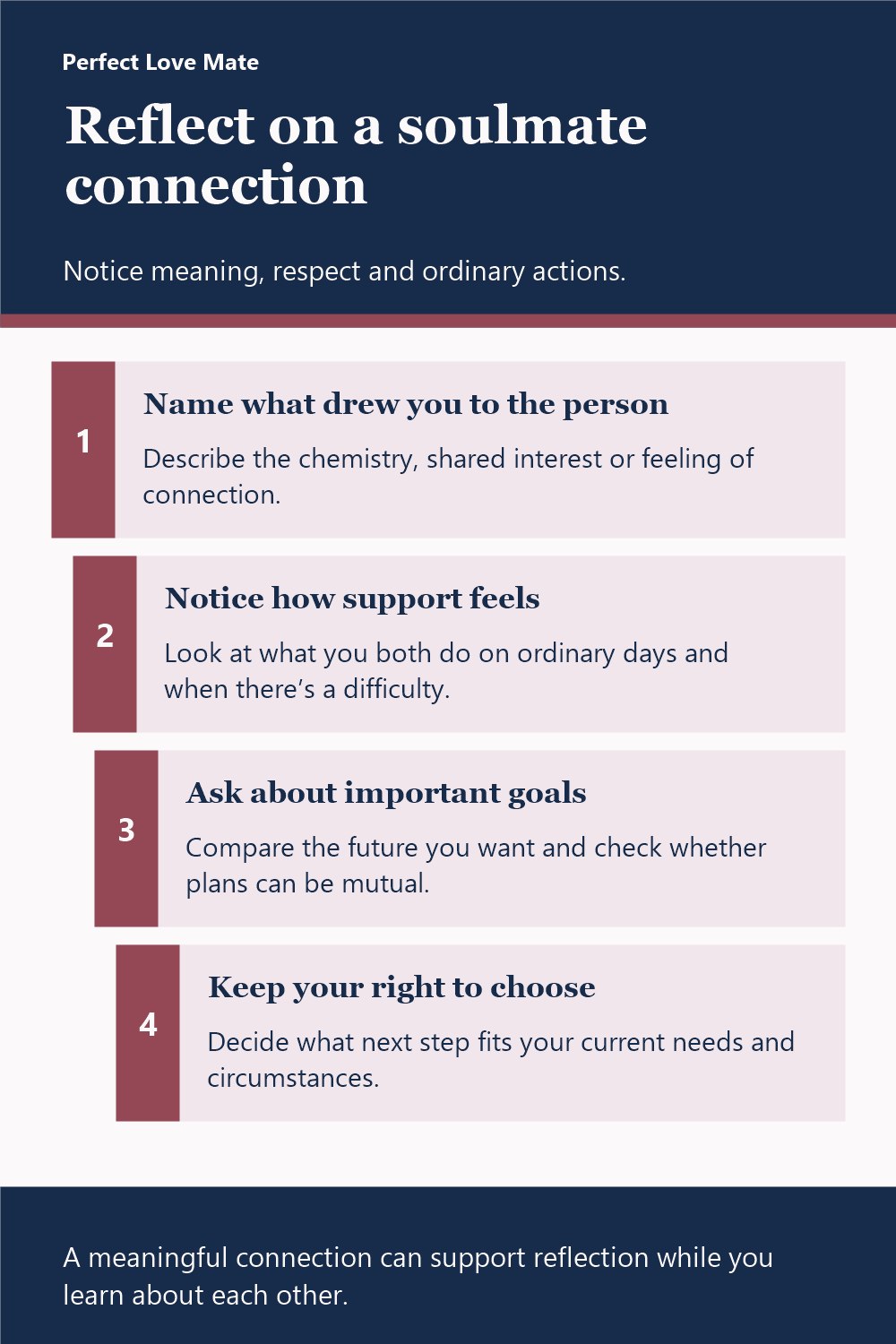
Reflect on a soulmate connection Notice meaning, respect and ordinary actions.
- Name what drew you to the person Describe the chemistry, shared interest or feeling of connection.
- Notice how support feels Look at what you both do on ordinary days and when there’s a difficulty.
- Ask about important goals Compare the future you want and check whether plans can be mutual.
- Keep your right to choose Decide what next step fits your current needs and circumstances.
A meaningful connection can support reflection while you learn about each other.