

A committed couple can choose to keep separate homes. Sometimes called living apart together, this arrangement may allow each person to keep familiar routines, responsibilities or private space while continuing the relationship.
Separate addresses do not automatically create independence, closeness or a better partnership. The important question is whether both people freely want the arrangement and can make its practical demands work. Start with a conversation about what you are choosing together.
On this page
1. Agree on what living apart means
Discuss why separate homes appeal to each of you. One person may want time alone; another may need to stay near work, children or someone they care for. Those reasons can coexist, but they need to be understood rather than guessed.
Clarify the relationship itself. Are you exclusive? How often would you like to meet? Are you choosing separate homes for the foreseeable future, trying an arrangement or postponing a decision about living together? Avoid assuming that you share the same plan because you use the same label.
If one person wants to live together and the other does not, name the disagreement kindly. Neither person has to accept an unwanted arrangement to prove their love. You may need more discussion, a realistic compromise or an honest recognition that your needs differ.

2. Consider children, caring and everyday routines
Keeping separate households may preserve some familiar routines, but it does not remove every effect of a new relationship. Consider visits, overnight stays, school mornings, travel and the space available to children or other household members.
Introduce changes at a manageable pace. Children can have feelings and practical needs without being asked to decide the adult relationship. Discuss the role each adult will have, who handles discipline and how you will protect time with your children.
Include care that is less visible. If someone becomes ill, has a demanding work week or needs practical help, what can the other person realistically offer? Separate homes do not make either person automatically responsible for providing care or exempt from discussing mutual support.
3. Make the practical arrangements visible
Look at the actual cost of maintaining two homes, including rent or mortgage payments, utilities, transport and time spent travelling. An arrangement that sounds appealing may be difficult to sustain within the resources you each have.
Decide how you will share dates, groceries during visits and other joint expenses. If one person regularly hosts, cooks, cleans or travels, acknowledge that work. Fairness may require different contributions, but the arrangement should be understood rather than quietly assumed.
Discuss keys, belongings, pets and notice before visits. Permission to visit is not unlimited access to a home. For questions about tenancy, ownership, benefits or other legal and financial consequences, use qualified local advice relevant to your situation.
4. Plan connection without giving up privacy
Choose ways to stay connected that suit your energy and schedules. A regular meal, a planned call or a shared activity may be useful. Leave room for a tired evening or a changed plan without treating every adjustment as rejection.
Ask about expectations around messages and time apart. Constant updates, location tracking or access to private accounts are not necessary proof of commitment. You can offer reassurance while keeping friendships, interests and ordinary privacy.
The NHS’s guidance on healthy relationships encourages honest communication and boundaries. In this arrangement, that means discussing needs directly rather than hoping physical distance will settle an unresolved conflict.
5. Review whether it works for both of you
Agree on a time to talk about how things are going, especially after a change in work, health or family responsibilities. There is no universal deadline by which separate homes must become one household.
Ask concrete questions: Is the travel manageable? Does each person have enough company and enough space? Is the practical effort shared fairly? Can either person raise a concern without being dismissed?
You may keep the arrangement, adjust it or choose a different future. Moving in together is not a required graduation, and living apart is not a repair for coercion or disrespect. A workable plan gives both people room to participate and to reconsider.
Read the infographic in text
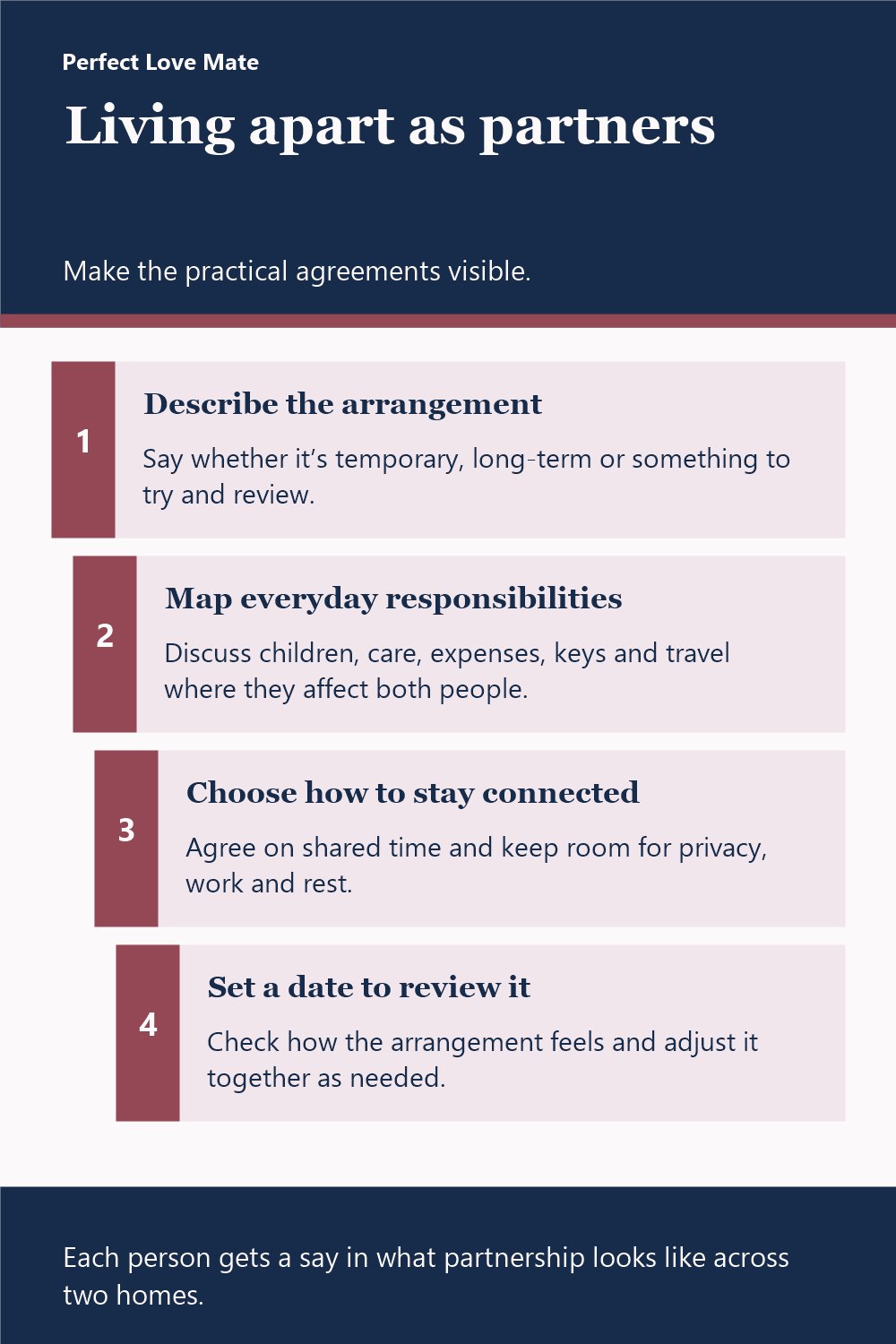
Living apart as partners Make the practical agreements visible.
- Describe the arrangement Say whether it’s temporary, long-term or something to try and review.
- Map everyday responsibilities Discuss children, care, expenses, keys and travel where they affect both people.
- Choose how to stay connected Agree on shared time and keep room for privacy, work and rest.
- Set a date to review it Check how the arrangement feels and adjust it together as needed.
Each person gets a say in what partnership looks like across two homes.