

A good relationship often shows itself in small moments: how you ask for help, respond to a disagreement or tell each other that something needs to change. You do not have to agree about everything to treat each other with care.
Choose one habit you both want to try this week. It should be clear enough that you can tell whether it made an ordinary day easier.
On this page
1. Accept differences while still naming what needs to change
You can appreciate your partner’s personality without expecting them to enjoy every activity you do. Ask whether a difference needs a compromise or simply room to exist: separate hobbies can work; agreements about shared time may need discussion.
Acceptance does not require putting up with insults or unwanted behavior. You can respect someone and still ask for a different arrangement or decide a difference matters too much.

2. Ask instead of assuming you know the reason
If your partner comes home quiet, try “Do you want some time alone, or would you like to talk?” It gives them room to say what is going on. You can ask for your own needs too: “Could we make ten minutes to talk after dinner?”
When you miss an expectation, name the event and the effect. “I didn’t hear that you’d be late, so I held dinner. Could you text next time?” gives you both something to act on.
3. Be kind while staying clear about the problem
Focus on the issue you want to solve. You can say, “I’m upset about how that decision was made, and I want to talk about it without calling each other names.” Keeping your voice calm does not mean agreeing or giving in.
If you are too upset to listen, agree to a pause and say when you can return. Make sure both people can ask for space without fear or pressure.
4. Repair small ruptures with a specific action
Try an apology that names what you did: “I interrupted you. I’ll let you finish and then check what I heard.” If someone apologizes to you, you can take time to decide what you need to see change.
Follow the apology with the action you named. A repeated change matters more to the agreement than saying the right thing once.
5. Make appreciation ordinary and review what helps
Thank your partner for something you actually noticed: “Thanks for letting me know the schedule changed; it gave me time to adjust.” Ask what they would like you to notice or do differently, and listen to the answer.
At the end of the week, name one thing you each want to keep and one adjustment to try. The habits work best when both people have room to ask, respond and choose how much they can offer.
Read the infographic in text
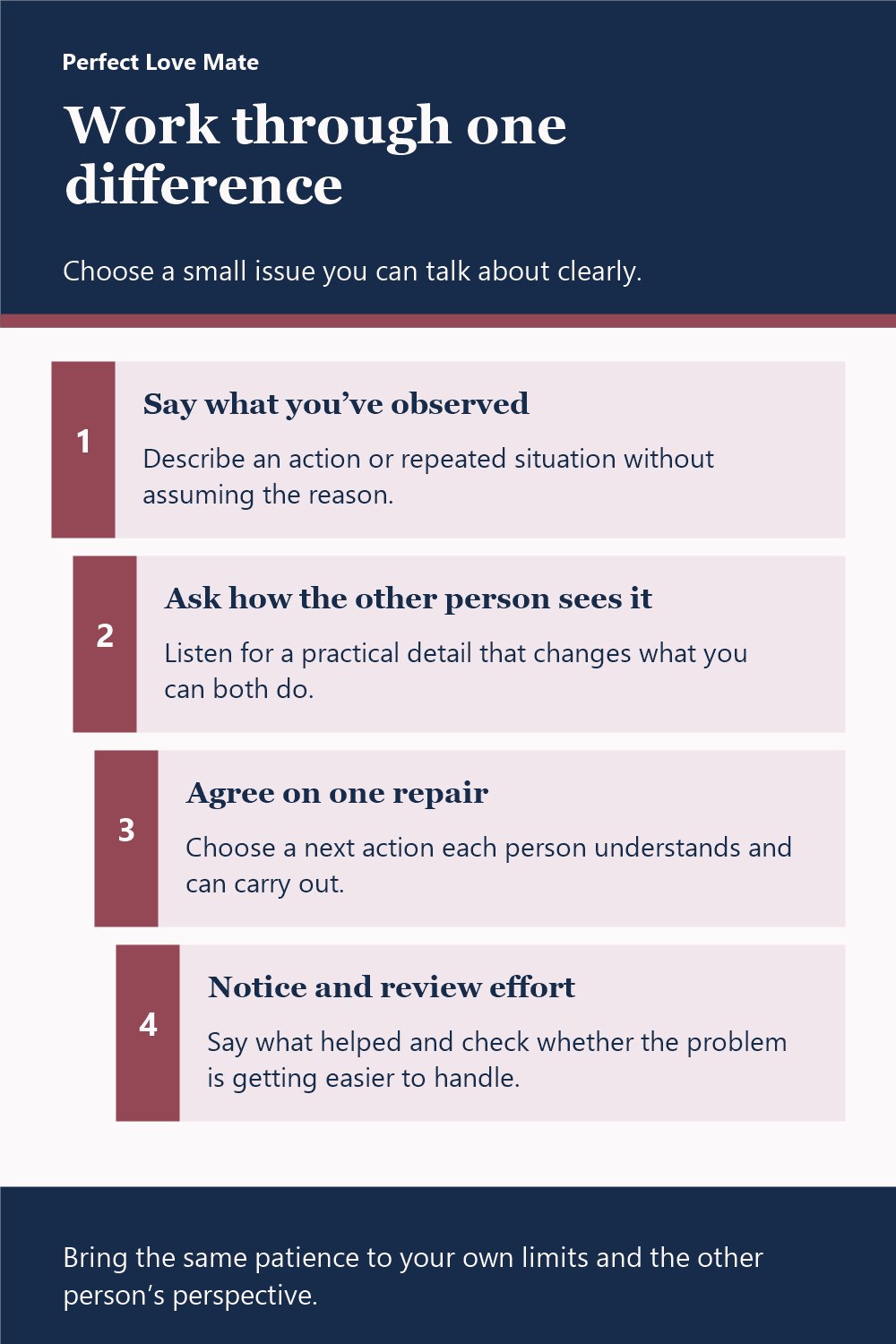
Work through one difference Choose a small issue you can talk about clearly.
- Say what you’ve observed Describe an action or repeated situation without assuming the reason.
- Ask how the other person sees it Listen for a practical detail that changes what you can both do.
- Agree on one repair Choose a next action each person understands and can carry out.
- Notice and review effort Say what helped and check whether the problem is getting easier to handle.
Bring the same patience to your own limits and the other person’s perspective.