

People use “soulmate” in different ways. For some, it is a spiritual belief about meeting someone for a reason. For others, it describes a person who feels unusually close or compatible. You can find either meaning valuable without expecting the label to settle every relationship question.
If you are wondering whether someone is your soulmate, ask what you mean by the word and what you know about the relationship itself.
On this page

1. Distinguish meaning from a claim about destiny
You might feel that you met someone at a meaningful moment or that you understand each other unusually well. That experience can matter to you. It does not establish that there is only one person you could love or that the other person understands the bond the same way.
You can use the term without agreeing on its spiritual meaning. If the difference matters, ask: “When you say soulmate, what do you mean?”
2. What relationship research has actually tested
In a 2014 study, researchers Spike Lee and Norbert Schwarz compared thinking of love as perfect unity with thinking of it as a journey. In their experiments, people who recalled conflict evaluated their relationships less favorably when thinking in terms of unity than when thinking in terms of a journey. The frame did not have the same effect after people recalled celebrations. The authors describe the experiments in a later research chapter.
That study examined judgments after people were prompted to think about their relationships in different ways. It did not test whether any couple was destined to meet or how long they would stay together.
3. Look at how the relationship works in ordinary life
Ask whether you can both say no, handle a change of plans, talk honestly and keep the agreements you make. A strong feeling can make you want to learn more; these ordinary moments give you details you can act on.
One disagreement does not settle whether you are a good fit. A pattern of disrespect or a lasting difference about what you want is worth taking seriously, even if the relationship feels special.
4. Leave room for your own choices
If the word helps you value someone and pay attention to the relationship, you can keep using it. If it makes you feel that you must stay, wait indefinitely or ignore the other person’s answer, return to what each of you actually wants and has agreed to.
You can end a relationship that does not fit your life even if it once felt deeply meaningful. You can also be content with a relationship without giving it a special name.
5. Ask one question that gives you usable information
Instead of trying to decide whether a bond is destined, ask “Can we talk about what we want this to become?” or “How do we each want to handle it when we disagree?” Listen for an answer you can understand and check against behavior.
If you are single, the idea of a soulmate need not set a deadline. Choose what you want from relationships, friends and daily life now, with room for those wishes to change.
Read the infographic in text
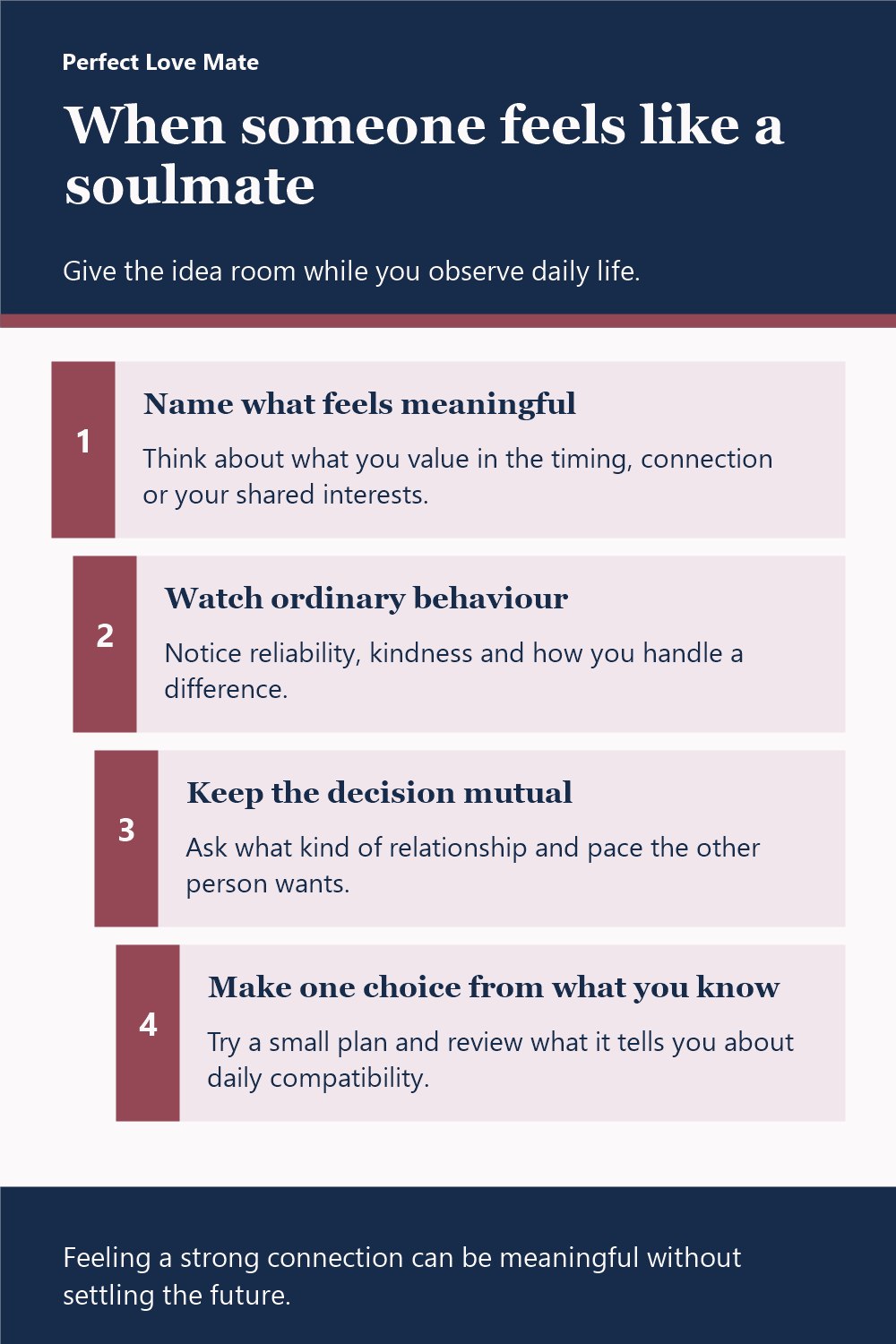
When someone feels like a soulmate Give the idea room while you observe daily life.
- Name what feels meaningful Think about what you value in the timing, connection or your shared interests.
- Watch ordinary behaviour Notice reliability, kindness and how you handle a difference.
- Keep the decision mutual Ask what kind of relationship and pace the other person wants.
- Make one choice from what you know Try a small plan and review what it tells you about daily compatibility.
Feeling a strong connection can be meaningful without settling the future.