

When you care about someone, it is understandable to wonder whether he feels the same. A warm look, a thoughtful gift or a message can matter to you, but none lets you read his mind. Love also does not require constant contact, complete self-sacrifice or a promise never to leave.
Consider what he says, what happens between you and whether the relationship being offered fits your needs. You can ask for clarity without proving that your uncertainty is unreasonable.
On this page
Ask what love means between you
If it feels safe to talk directly, ask about the relationship you want to understand: “How do you see us?” or “When you say you love me, what does that mean for our relationship?” You may be asking about affection, exclusivity, a shared future or something else. Name the question rather than relying on a broad declaration.
Someone may care for you and still want a different arrangement. Listen to the answer as it is now. An unclear answer is information about the clarity available; it is not proof of hidden devotion or deliberate deception.
Let giving remain a choice
A gift, favour or generous gesture can express care. It does not purchase affection, sex, access to your private life or agreement with a decision. Notice whether both people can give within their means and say no without punishment.

Look at everyday consideration
Describe the pattern you can see. Are plans discussed, changes communicated and agreements generally kept? If something repeatedly falls through, can you talk about its effect and find a workable alternative? These questions help you assess the relationship without assigning a score for how often he texts.
Being important does not require coming first in every circumstance. Work, children, health and other responsibilities can shape availability. Your needs still deserve a realistic conversation about what each person can offer.
Discuss a place in each other’s lives
Meeting friends or family may be meaningful, but it is not a universal test of love. Privacy, family conflict, distance or safety can affect introductions. Ask what involvement you both want and what practical limits exist.
Make room for learning
Interest can include asking about your experiences and remembering what matters to you. It does not mean knowing everything without being told. Explain an important preference directly rather than testing whether he notices a small change.
Notice how differences are handled
A loving feeling does not prevent irritation or disagreement. Pay attention to whether you can raise a concern, refuse a request or hold another view while remaining respected. A useful apology names the behaviour and is followed by an effort to change it.
You are not responsible for keeping someone happy at all times, and he is not responsible for removing every difficult feeling you have. Shared care can include listening, practical help and honest limits.
Agree on contact that fits
Missing someone does not have a required outward form. Talk about the kind of contact you enjoy and can sustain. A delayed reply is not a verdict, while an ongoing mismatch may need a decision about compatibility.
Keep privacy within closeness
Sharing plans can be considerate. Requiring passwords, location reports or immediate replies is a different demand. You can be close without giving up privacy or having to account for every ordinary movement.
Keep support and independence together
Ask for a specific kind of help when you need it, and listen to what is possible. One partner cannot meet every need or be available in every situation. Keep other sources of friendship, practical support and enjoyment in your life. Staying yourself in a relationship can make those choices easier to discuss.
Do not use endurance as proof
Working through a difficulty can be a shared choice. Remaining together through every circumstance is not a requirement of real love. Repeated threats, humiliation or control deserve support and careful attention, even when there is affection.
Choose from the relationship available
After talking, ask what you now know. Are your wishes understood? Is there an agreement you both want? Does behaviour broadly support it? You can allow time for a specific change, accept a limit or decide that this arrangement does not suit you.
No list can guarantee his feelings or your future. You deserve honest information and room to choose, rather than having to become perfectly calm or stop needing reassurance before your questions count.
Read the infographic in text
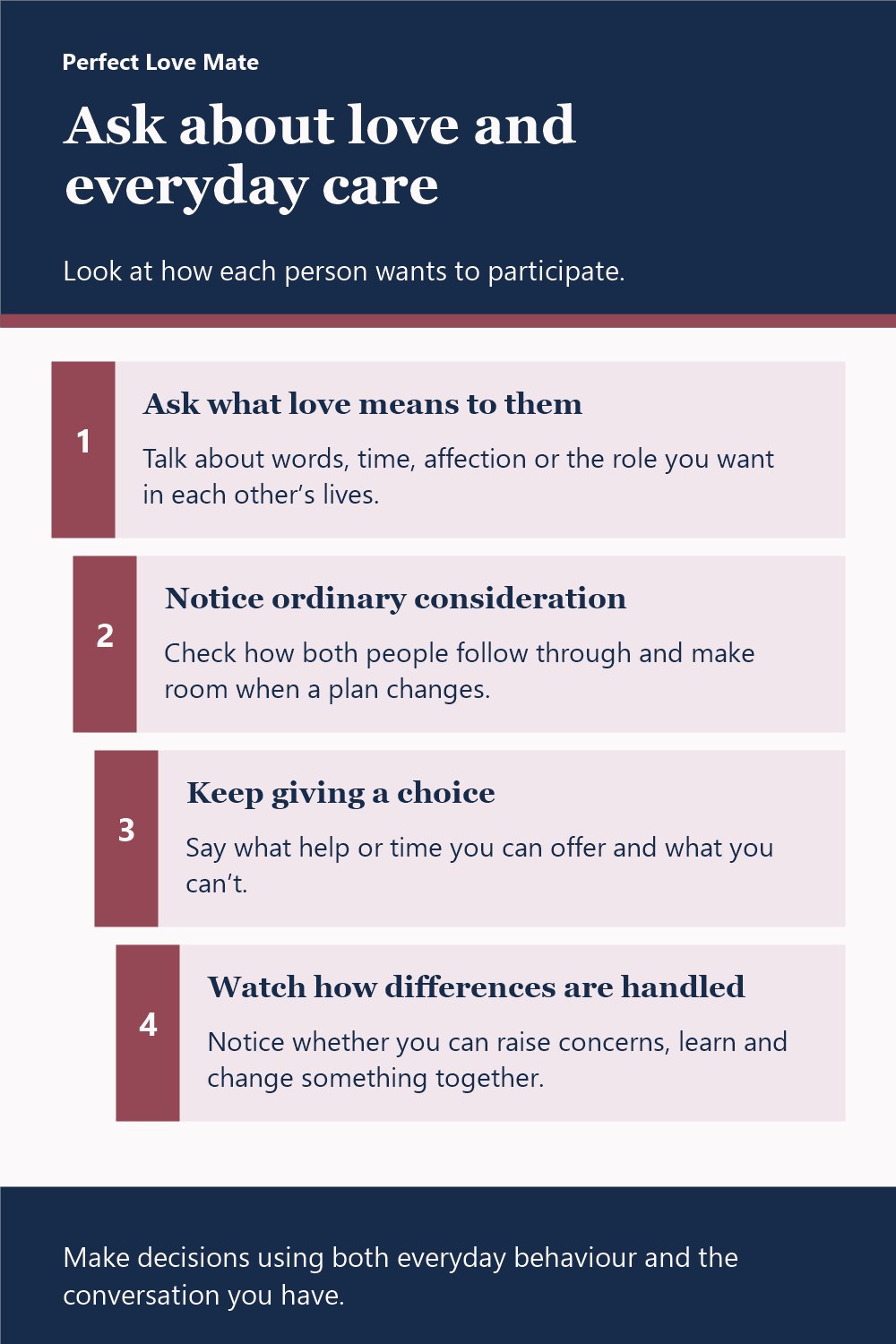
Ask about love and everyday care Look at how each person wants to participate.
- Ask what love means to them Talk about words, time, affection or the role you want in each other’s lives.
- Notice ordinary consideration Check how both people follow through and make room when a plan changes.
- Keep giving a choice Say what help or time you can offer and what you can’t.
- Watch how differences are handled Notice whether you can raise concerns, learn and change something together.
Make decisions using both everyday behaviour and the conversation you have.